
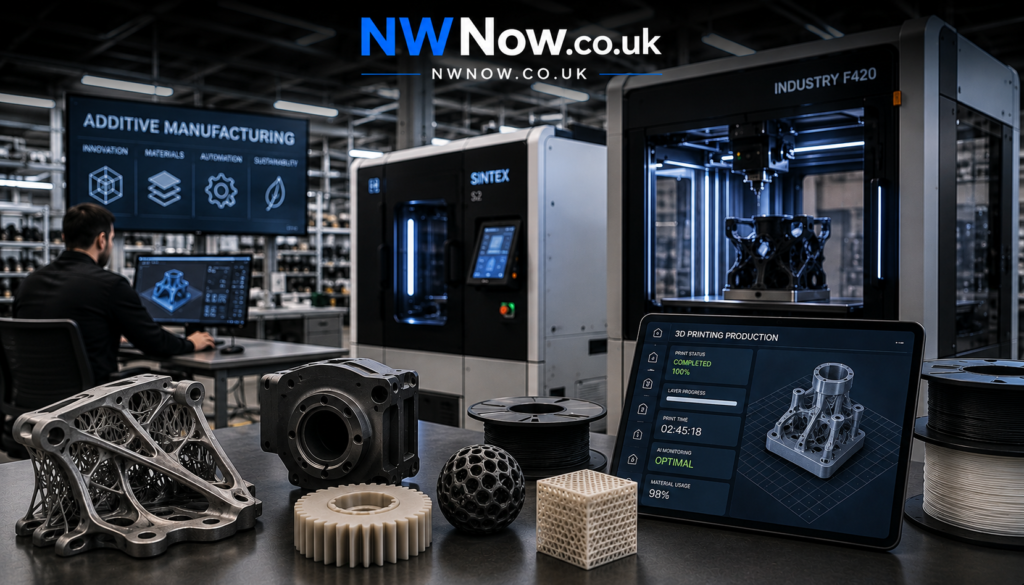

3D printing, or additive manufacturing, has long promised a future where we could simply “print” almost anything. For years, that promise felt just out of reach, constrained by slow speeds, high costs, and limited materials. The narrative was one of immense potential, but the reality was often restricted to prototyping.
However, 2026 marks a definitive turning point. The industry is no longer asking if 3D printing is possible, but rather how reliable and efficient it has become. This shift is driven by a convergence of innovations in speed, materials, and intelligence, moving the technology from the design lab to the production line.
This article explores the key 3D printing innovations defining 2026, from groundbreaking technologies like holographic printing to market growth and real-world industrial applications.
Market Growth and Industry Maturity
The numbers tell a clear story: 3D printing is a rapidly maturing industry. In the first quarter of 2026 alone, the global 3D printing markets totalled $4.35 billion, representing a 13.1% year-over-year growth. This growth is driven by the technology’s transition from a prototyping tool to a viable method for end-use part production.
Looking ahead, the market is projected to grow from $28.39 billion in 2026 to a staggering $59.24 billion by 2032. This expansion is fuelled by global supply chain reorganisations and government-backed defence initiatives where traditional manufacturing cannot provide fast enough solutions.
Key Innovations in 3D Printing
Holographic Printing: A Leap in Speed and Precision
One of the most exciting innovations is a new holographic 3D printing method developed by the University of Utah. Instead of building objects layer by layer, this technology uses a nanoscale mask to diffract laser light into a holographic pattern. This fuses the print material solid in a single shot, taking about 20 seconds—a stark contrast to the hours other laser-based methods can take.
This technique, which the researchers describe as a “cookie cutter” stamping a complex shape out of thick dough, allows for the printing of complex microstructures with extreme fine detail. This represents a fundamental shift from “stacking bricks” to “instant sculpting,” opening new doors for precision manufacturing.
The Rise of Multi-Material and High-Performance Systems
2026 is also a landmark year for material versatility. Traditionally, 3D printing was limited to single materials. Now, innovations are enabling the printing of complex, functional parts that combine different properties.
Multi-Material Printing: Researchers at the Karlsruhe Institute of Technology (KIT) have developed a breakthrough system called CeraMMAM. This technology allows for the production of high-performance components from multiple materials, such as different ceramics or ceramics and metals, in a single printing process. This enables entirely new designs, like ceramic gears with flexible interiors and hard surfaces, previously impossible to manufacture.
High-Performance Polymers: The adoption of high-performance thermoplastics like PEEK and PEKK, as well as carbon fibre-reinforced composites, has risen sharply. These materials allow printed parts to approach the strength of metals, making them ideal for lightweighting in aerospace, automotive, and medical applications.
AI-Driven Automation: The Smart Factory
The human element is changing too. AI is being integrated to automate tedious tasks, monitor print processes in real-time, and reduce failure rates. For instance, AI monitoring and closed-loop control can adjust printing parameters during a build to correct flaws, moving the process from being operator-dependent to system-reliable.
This push towards “lights-out” manufacturing also includes AI-driven automated nesting, build preparation, and workflow management. Combined with faster print speeds, these innovations have reduced the cost-per-part for 3D printing by approximately 40% compared to three years ago.
Key Takeaways
-
The 3D printing market is experiencing rapid growth, with Q1 2026 totalling $4.35 billion and a projected 13.1% year-over-year increase.
-
Holographic printing is a game-changing technology that can create complex 3D shapes in seconds, avoiding the slow, layer-by-layer approach.
-
Multi-material printing has advanced significantly, with new processes enabling the combination of ceramics, metals, and high-performance polymers in a single part.
-
The integration of AI and automation is making 3D printing faster, more reliable, and more cost-effective, with cost-per-part dropping significantly.
-
The industry is transitioning from a prototyping-centric model to a key player in manufacturing, especially for low-to-medium volume, complex, and customised parts.
Frequently Asked Questions
What is the latest 3D printing innovation?
One of the latest and most significant 3D printing innovations is holographic printing, which can fuse a 3D object in a single shot in about 20 seconds, greatly increasing speed and precision.
What is the current size of the 3D printing market?
The 3D printing market was valued at $4.35 billion in the first quarter of 2026, showing a 13.1% year-over-year growth.
Is 3D printing being used for production or just prototyping?
While prototyping remains a major use, 2026 marks a turning point. Innovations in speed, materials, and AI are making 3D printing increasingly viable for end-use production and small-batch manufacturing.
How is AI being used in 3D printing?
AI is used for real-time monitoring and closed-loop control to reduce print failures. It also plays a key role in automating workflows, nesting parts, and optimising build processes to increase efficiency.
What are the latest advancements in 3D printing materials?
Key advancements include a wider adoption of high-performance materials like PEEK, carbon fibre composites, and new multi-material systems that can combine different ceramics and metals in a single print.
What is multi-material 3D printing?
Multi-material 3D printing is the ability to print a single part using two or more different materials, such as a hard ceramic exterior with a flexible interior. This allows for the creation of components with properties that were previously impossible to manufacture.
Can 3D printing be sustainable?
Yes. Additive manufacturing is inherently less wasteful than subtractive methods. Innovations in material reuse, as well as the ability to print parts locally rather than shipping them across the globe, are making it a more sustainable manufacturing option.
Conclusion
The 3D printing innovations of 2026 are not just incremental improvements; they represent a fundamental shift. By addressing the historical bottlenecks of speed, materials, and reliability, the industry is proving that additive manufacturing is a robust, scalable, and cost-effective solution for industrial production. From holographic printing that sculpts objects in seconds to AI-driven systems that ensure flawless builds, the future of making things is being rewritten.
Read more Johan Riley Fyodor Taiwo Samuel: Heidi Klum & Seal’s Son