
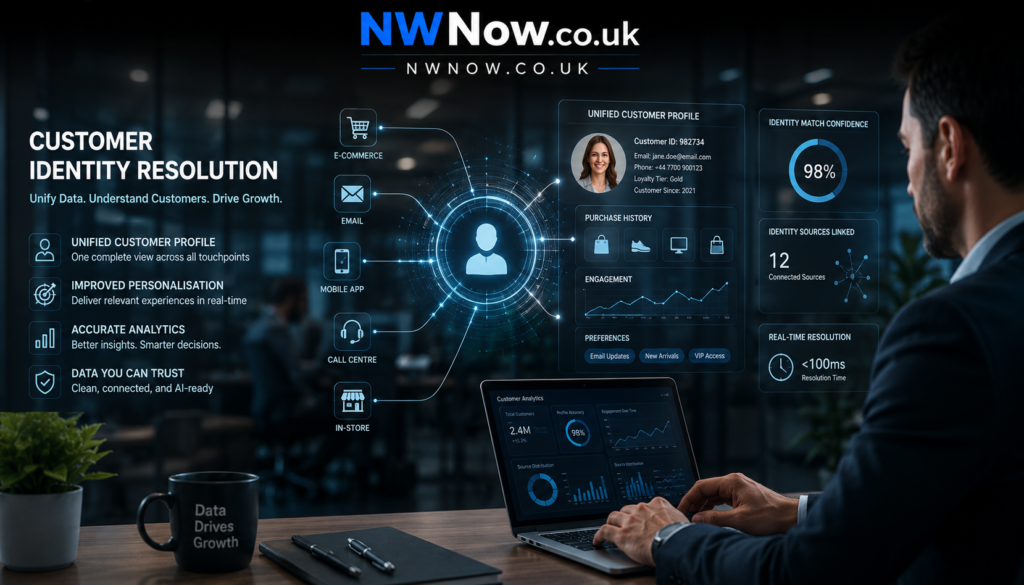

Enterprises today face a fundamental challenge: their customers are everywhere, but their data is scattered. A single individual might appear as three different records across your CRM, e-commerce platform, loyalty program, and call centre systems. Each system holds a fragment of the overall customer journey, often with variations in names, contact details, or other information .
Customer identity resolution is the strategic process of stitching these fragmented data points together to build an accurate, comprehensive profile for each individual . Without it, brands risk mis-targeting customers, wasting marketing budgets, and derailing AI initiatives that depend on clean, connected data .
This article explores the key enterprise initiatives driving identity resolution in 2026, from cloud-native solutions like AWS Entity Resolution to real-time platforms from Salesforce and adaptive approaches from Hightouch. It also covers best practices, common challenges, and the strategic importance of unified customer profiles.
What Is Customer Identity Resolution?
Customer identity resolution is the process of identifying and merging customer records across various systems and touchpoints to create a single, trusted view of each individual . It answers a critical question: how do you know that the person browsing your website today is the same person who visited your store last week, called your support line yesterday, and holds a loyalty account?
The process uses matching rules to link records based on identifiers such as email addresses, phone numbers, loyalty card numbers, and device IDs . When a match is found, merge rules determine how conflicting information from different sources is reconciled, often prioritising data from more trusted applications .
Identity resolution can operate in different timeframes. Batch processing handles large volumes of data on a scheduled basis, while real-time identity resolution identifies and merges customer records in milliseconds as customers engage with your platform .
Why Identity Resolution Matters for Enterprise Initiatives
The Fragmentation Problem
Customer data is scattered across multiple systems: CRMs, e-commerce platforms, loyalty programs, call centres, mobile apps, and physical stores . Each system stores data differently, and most weren’t built to connect. The result is an inconsistent, often conflicting view of the customer .
Research suggests that fragmented systems can reduce profile accuracy by up to 25%, harming personalisation, reporting, and return on investment . One person might appear as multiple records with profile details that don’t agree or sync, and key attributes like contact information, transaction history, or behavioural data may live in entirely separate places .
The Cost of Inaction
Without identity resolution, enterprises face:
-
Ineffective personalisation: The same customer may be targeted multiple times or missed altogether, weakening consumer trust and loyalty
-
Unreliable analytics: Duplicate and incomplete records inflate customer counts and distort engagement metrics, making KPIs unreliable
-
High operational costs: Brute-force approaches that reprocess duplicates and unchanged data drive up storage, compute, and licensing costs
-
Derailed AI initiatives: AI promises breakthrough personalisation, but only if it has accurate, connected customer profiles as input
The Strategic Opportunity
A 2025 MIT Technology Review survey found that 78% of global organisations do not feel “very ready” to implement AI tools like large language models or AI agents, with data readiness identified as the biggest challenge . By investing in identity resolution, enterprises build the unified data foundation that powers smarter AI, more effective marketing, and superior customer experiences.
Key Enterprise Initiatives and Platforms
AWS Entity Resolution
Amazon Web Services (AWS) Entity Resolution helps companies quickly match, link, and enhance related customer records, enabling a move from scattered records to unified customer views . Companies can use flexible, configurable rules or machine learning matching techniques based on their business needs.
A modular pipeline solution built on AWS Entity Resolution demonstrated significant results:
-
Over 80% reduction in operational costs
-
Over 95% improvement in processing time
The pipeline ingests customer data from multiple sources, applies rule-based matching to remove duplicates, and consolidates records into a single “golden record” for each identity cluster . This unified view powers accurate analytics, personalised marketing campaigns, and consistent customer service experiences .
Salesforce Real-time Identity Resolution
Salesforce Data Cloud’s Real-time Identity Resolution identifies and merges customer records as soon as a customer engages with a platform, providing a complete view in milliseconds . When a loyal in-store customer anonymously visits a retailer’s website, the system applies predefined matching rules (such as email address, phone number, or loyalty card ID) to merge their current browsing session with their in-store purchase history.
This real-time approach enables:
-
Immediate customer recognition: When a customer contacts support, agents see a complete view of past interactions
-
Personalised assistance: Agents access historical purchases and preferences for tailored recommendations
-
Proactive engagement: Relevant insights are surfaced to agents in real-time
The system processes requests in under 100 milliseconds, using a “key ring” architecture where each unified profile has a unique identifier representing a set of keys linked together via match rules .
Hightouch Adaptive Identity Resolution
Hightouch’s Adaptive Identity Resolution (AIR), built on Databricks, delivers in-house identity resolution capabilities using first-party data . What sets AIR apart is its ability to toggle between degrees of certainty in establishing customer identities.
Using a multi-zone approach:
-
High-confidence zone: Uses exact, deterministic matching for precision-critical use cases like billing communications, customer service interactions, and compliance
-
High-reach zone: Uses AI-based probabilistic matching that accounts for variations to deliver scale and reach, suitable for early customer engagement and broad advertising
This flexibility allows organisations to choose the confidence level across use cases, maximising both accuracy and growth potential . By keeping data in the customer’s Databricks environment, AIR preserves data privacy and enables compliance with geographic restrictions on consumer data movement.
SAP Customer Data Platform
SAP Customer Data Platform provides identity resolution through matching and merge rules . Matching rules specify which attributes will be used as customer data identifiers, while merge rules determine what happens when incoming data matches existing records .
Key features include:
-
Application identifiers: Attributes that are immutable and cannot be overridden, suitable for high-trust identifiers like CRM IDs
-
Mutable identifiers: Attributes that can be updated, such as email addresses
-
Data quality ranking: When conflicting data is received from sources with different trust levels, the system prioritises data from the application with higher quality ranking
The platform supports both unified customer profiles and contextual profiles, enabling different views of a single customer based on the strength of matching and confidence in data accuracy .
Key Strategies for Offline-to-Online Identity Resolution
One of the trickiest identity resolution challenges is merging offline customer behaviours (in-store purchases, phone calls, physical interactions) with online identities. Several strategies can address this.
Known Identifiers Through Loyalty Programs
Companies with strong loyalty programmes have a significant advantage. They typically collect phone numbers or emails during both offline and online transactions, enabling exact-match deterministic resolution . Some retailers capture known identifiers in more than 80% of their transactions through loyalty programmes.
Point-of-Sale (POS) Data
When companies don’t consistently collect phone numbers or emails during in-store transactions, POS data can bridge the gap. Payment data provides:
-
Last four digits of credit cards
-
Credit card tokens (PAR, DPAN, or POS tokens)
-
Store postal codes
Using credit card tokens, companies can use deterministic identity resolution to merge online and offline transactions, with probabilistic methods layered on to further increase resolution.
Third-Party Identity Spines
For companies lacking robust loyalty programmes or consistent access to credit card tokens, third-party identity spines from providers like Experian and Cardlytics can bridge the gap . These vendors maintain large-scale consumer identity graphs that link fragmented data across email addresses, phone numbers, and credit card transaction data.
Best Practices for Enterprise Identity Resolution
Automate Data Preparation
Manual data preparation is time-consuming and complex. AI-powered tools can now ingest and standardise data from various sources in hours instead of months, eliminating repetitive work and making data teams more efficient .
Use Multi-Dimensional Matching
Different use cases require different matching techniques. Some require exact, deterministic matching (like fraud detection), while others benefit from broader, probabilistic models (like marketing segmentation). The best systems use a combination of both to balance precision with scale .
Prioritise Transparency and Quality Assurance
Many legacy identity resolution systems are black boxes. Modern platforms should provide a visual interface where teams can inspect match results, evaluate accuracy, and fine-tune matching strategies over time .
Ensure Architectural Flexibility
Enterprises often rely on a mix of disparate data platforms for analytics and storage. Identity resolution solutions should plug directly into existing data environments with native zero-copy data sharing and support easy testing and deployment for model iteration and new data sources without disrupting production systems .
Establish Data Governance
A thorough consistency policy helps standardise records as they arrive, converting date formats, enforcing naming conventions, and validating addresses . Deduplication processes often rely on confidence scores to eliminate obviously redundant entries while avoiding data loss. Ongoing auditing can pinpoint where match rates slip due to new data sources or changes in data models.
Key Takeaways
-
Customer identity resolution stitches together fragmented customer data across systems to create unified, accurate profiles
-
Fragmented systems can reduce profile accuracy by up to 25%, harming personalisation, reporting, and ROI
-
AWS Entity Resolution achieved over 80% cost reduction and 95% processing time improvement for one enterprise customer
-
Salesforce offers real-time identity resolution with sub-100 millisecond processing for immediate customer recognition
-
Hightouch’s Adaptive Identity Resolution provides flexible confidence levels, balancing precision with reach
-
Offline-to-online identity resolution can be achieved through loyalty programmes, POS data, and third-party identity spines
-
Best practices include automated data preparation, multi-dimensional matching, transparency, and architectural flexibility
Frequently Asked Questions
What is customer identity resolution?
Customer identity resolution is the process of identifying, matching, and merging customer records across various systems and touchpoints to create a single, trusted, and comprehensive profile for each individual .
Why is identity resolution important for enterprises?
It enables accurate personalisation, reliable analytics, cost reduction, and successful AI initiatives. Without it, enterprises risk mis-targeting customers, wasting budgets, and derailing AI projects that depend on clean data .
What are the main approaches to identity resolution?
The two main approaches are deterministic (exact) matching using known identifiers like email addresses, and probabilistic matching that uses AI to infer connections across messy or incomplete data .
How does real-time identity resolution differ from batch processing?
Real-time identity resolution processes customer data in milliseconds as customers engage with a platform, enabling immediate personalisation. Batch processing handles large volumes of data on a scheduled basis for deep analysis and profile unification .
What are the key technologies used for identity resolution?
Key technologies include AWS Entity Resolution, Salesforce Data Cloud, SAP Customer Data Platform, Hightouch Adaptive Identity Resolution on Databricks, and various third-party identity spines .
How do you merge offline and online customer data?
Strategies include using loyalty programme identifiers, point-of-sale credit card data, and third-party identity spines that link fragmented data across email addresses, phone numbers, and transaction data .
What is a golden record in identity resolution?
A golden record is the single, consolidated profile created after matching and merging records from various sources. It represents the most complete and trusted view of a customer, prioritising the most recent and complete attributes .
Conclusion
Customer identity resolution has become a strategic imperative for enterprises in 2026. As data volumes grow and AI adoption accelerates, the ability to unify fragmented customer records into trusted, comprehensive profiles directly impacts business performance. Platforms like AWS Entity Resolution, Salesforce Data Cloud, and Hightouch Adaptive Identity Resolution offer powerful solutions for different enterprise needs, from real-time personalisation to flexible confidence-based matching.
The organisations that invest in identity resolution today are building the foundation for smarter AI, more effective marketing, and superior customer experiences. In a world where customer expectations for personalisation are higher than ever, identity resolution is not just a technical initiative—it is a business imperative.
Read more Double Jaw Surgery: Procedure, Recovery, and Costs Explained