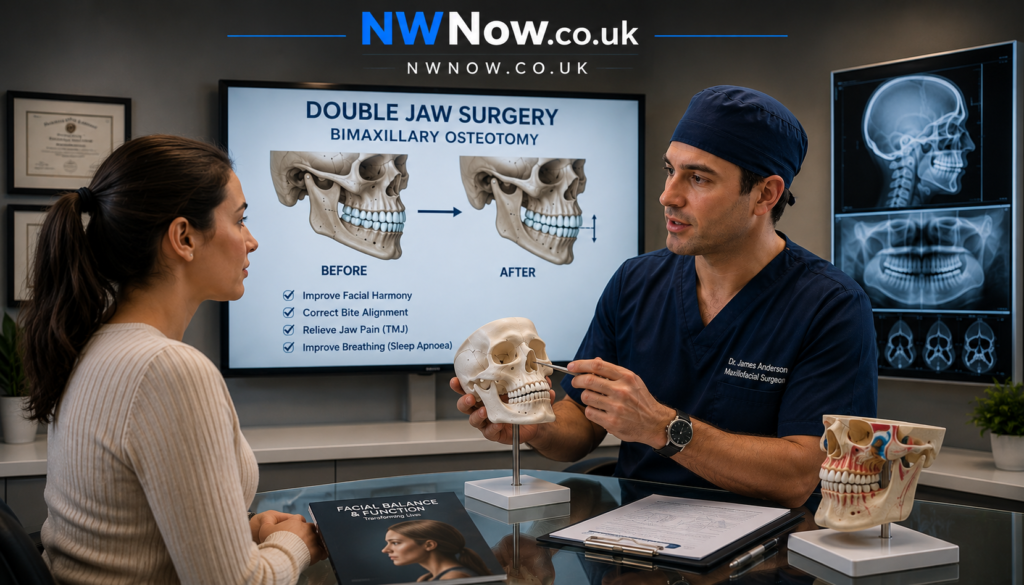

Double jaw surgery, also known as bimaxillary osteotomy, is a life-changing procedure that realigns the upper and lower jaws to improve facial appearance, oral health, and function . Performed by highly trained maxillofacial surgeons, this advanced surgical technique addresses everything from chronic jaw pain and misalignment to obstructive sleep apnoea and temporomandibular joint (TMJ) disorders .
For many patients, jaw abnormalities cannot be corrected with braces alone. Orthognathic surgery offers a comprehensive solution, combining orthodontic treatment with surgical repositioning of the jaw bones. This article provides a complete guide to double jaw surgery, covering the procedure, recovery timeline, costs, risks, and what to expect.
What Is Double Jaw Surgery?
Double jaw surgery corrects irregularities in both the upper jaw (maxilla) and lower jaw (mandible), bringing them into proper alignment. The procedure typically includes a maxillary osteotomy to reposition the upper jaw and a mandibular osteotomy to adjust the lower jaw .
The upper jaw surgery, known as a Le Fort I osteotomy, involves separating the maxilla from other facial bones. This allows the upper teeth to be moved forward, rotated, or shifted up or down to lengthen or shorten facial appearance . The lower jaw procedure, called a bilateral sagittal split osteotomy, makes precise cuts on both sides of the mandible, allowing the lower teeth and chin to be moved forward, backward, or rotated .
Combined Le Fort I and bilateral sagittal split osteotomies address more complex deformities affecting both jaws. People with significant facial asymmetry, abnormalities in both jaws, larger distances between their upper and lower teeth, or syndromic conditions may require this operation .
Who Needs Double Jaw Surgery?
Patients who require both upper and lower jaw surgery often suffer from issues that cannot be corrected with braces alone. Corrective jaw surgery is typically recommended for individuals with :
Functional Issues:
-
Jaw misalignment such as open bite, protruding jaw, or underbite
-
Difficulty chewing or speaking
-
Obstructive sleep apnoea caused by airway obstruction
-
Chronic temporomandibular joint pain or TMJ disorders
Aesthetic Concerns:
-
Facial asymmetry or trauma
-
Imbalance of facial bones and teeth
As many as 15% of people have dental and jaw abnormalities that cannot be corrected with braces alone and may be candidates for orthognathic surgery . The surgery is usually recommended after jaw growth is complete, typically in early adulthood .
The Surgical Process
Pre-Surgery Planning
Orthognathic surgery is completed with a team comprising a surgeon and an orthodontist. The orthodontist uses braces and other appliances to align the teeth appropriately in both jaws . Prior to beginning treatment, the orthodontist will take X-rays, photographs, and dental impressions.
Extensive analysis determines the best treatment plan. Typically, an appointment to meet with a surgeon is made early in orthodontic treatment. Once the orthodontist is nearing completion of treatment, a full set of orthodontic records will be taken again to plan the operation .
This includes CT scans, photographs, and digital scans of the teeth. The collected information is used by the surgeon to design a virtual surgical plan. 3D printing technology creates custom dental splints and plates and screws, allowing each patient’s surgery to be specific to their needs with increased precision and safety .
The Operation
The surgery is performed under general anaesthesia in a hospital and usually lasts several hours . The surgeon makes incisions inside the mouth to reposition the jawbone, avoiding visible scarring. Titanium plates and screws hold the jaws in their new positions .
Most patients spend 1 to 2 nights in the hospital after double jaw surgery . Some patients with more complex cases may stay for 3 to 4 nights .
Recovery Timeline
The recovery period varies, but most patients return to normal activities within 6 to 8 weeks, though complete healing takes 9 to 12 months . The overall treatment process typically lasts two to three years, combining the surgery itself with orthodontic treatment before and after .
First Week
Maximum swelling and discomfort are expected, with swelling peaking around days 3 to 5 . Patients remain on a strict liquid diet and typically feel very tired. Most patients stay in the hospital for 1 to 2 days .
Weeks 2-4
Swelling starts decreasing, and patients can begin adding soft foods to their diet . Most patients return to work or school during this period, though the time needed off work is generally 2 to 4 weeks . Pain improves significantly.
Weeks 4-6
This marks a major healing milestone . Patients can return to light exercise and most daily activities. Those who have had bimaxillary surgery may need to continue a soft diet for up to 8 to 12 weeks .
3-6 Months
Bone healing continues, and the final facial appearance becomes clearer. Most restrictions are lifted .
6-12 Months
Complete bone healing finishes, and final results become visible . Regular follow-up appointments continue.
Risks and Complications
While double jaw surgery is generally safe, it carries potential risks. A 2023 study analysing 674 orthognathic surgery patients found a 30-day complication rate of 4.3%, with superficial incisional infection being the most common surgical complication .
Potential Risks Include :
-
Bleeding during or after the procedure
-
Infection at the surgical site
-
Temporary or permanent nerve damage or numbness in the lips and face
-
Relapse where the jaw shifts back toward its original position
-
Jaw stiffness that may require physical therapy
Pharyngeal Complications
A 2024 study published in Cureus examined pharyngeal complications following two-jaw surgery. The study found that 9.8% of patients experienced vocal cord paralysis, attributed to mechanical irritation of the larynx due to movement of the intubation tube during surgery and compression of perilaryngeal tissues . All patients improved within two months postoperatively.
Laryngeal granulation occurred in 4.5% of patients, with full recovery in all cases within 2 to 8 months through conservative treatment .
Common Side Effects :
-
Numbness in the lips, chin, and mouth (usually improves gradually)
-
Swelling in the face and lips (most prominent in the first week)
-
Weight loss due to difficulty eating (many patients lose at least 15 pounds in the first 3 months)
-
Limited mouth opening that improves with physiotherapy after 3 months
Nerve Damage
All patients will have numbness or altered sensation in the lower face, including the lips, following surgery. This is due to nerve stretching caused by jaw movement. Sensation typically returns fully in the vast majority of patients, though it can take several months. Older patients or those with medical conditions like diabetes may experience slower recovery .
Cost of Double Jaw Surgery
The cost of double jaw surgery varies significantly by country:
| Country | Double Jaw Surgery Cost | Key Inclusions |
|---|---|---|
| United States | $40,000 – $55,000 | Surgery, hospital, anaesthesia, orthodontics |
| United Kingdom | £20,000 – £30,000 | Surgery, hospital, follow-ups |
| Germany | $14,000 – $28,000 (€12,000–€25,000) | Often covered by public health insurance |
| Turkey | $5,500 – $12,000 | Surgery, hospital stay, medications, transfers |
Turkey has become a leading destination for medical tourism, with savings of 60-80% compared to the US or UK . These packages typically include surgery, hospital stay, medications, and transfers. JCI-accredited hospitals and surgeons trained in Europe or the US maintain high safety standards.
Key Takeaways
-
Double jaw surgery (bimaxillary osteotomy) realigns both upper and lower jaws to correct functional and aesthetic issues
-
The procedure is performed under general anaesthesia and usually requires 1-2 nights in the hospital
-
Initial recovery takes 6-8 weeks, while complete bone healing takes 9-12 months
-
Success rates are high, with over 94% of surgeries successful when patients follow recovery plans
-
A 2023 study of 674 patients found a 4.3% complication rate within 30 days
-
Costs range significantly by country, with the US averaging $40,000–$55,000 and Turkey offering more affordable packages starting around $5,500
-
The procedure is often combined with orthodontic treatment lasting 12-18 months before and 6 months after surgery
Frequently Asked Questions
What is double jaw surgery?
Double jaw surgery, also known as bimaxillary osteotomy, is a surgical procedure that corrects irregularities in both the upper jaw (maxilla) and lower jaw (mandible). It is performed to improve jaw function, breathing, and facial appearance .
How long does double jaw surgery recovery take?
Most patients return to normal activities within 6-8 weeks, though complete healing takes 9-12 months. The initial hospital stay is typically 1-2 nights. A liquid or soft diet is required for about 6 weeks after surgery .
What conditions does double jaw surgery treat?
It treats severe jaw misalignment (overbite, underbite, open bite), obstructive sleep apnoea, chronic TMJ pain, facial asymmetry, and difficulties with chewing, speaking, or breathing that cannot be corrected with braces alone .
How much does double jaw surgery cost?
Costs vary significantly by country. In the US, double jaw surgery averages $40,000-$55,000. In the UK, it averages £20,000-£30,000. In Turkey, costs start around $5,500-$7,500. Insurance may cover medically necessary cases .
Is double jaw surgery painful?
Patients typically report discomfort rather than sharp pain. Pain is generally well-managed with medications. Most patients notice numbness and swelling more than pain, with the most significant discomfort occurring in the first week after surgery .
What are the risks of double jaw surgery?
Risks include bleeding, infection, nerve damage causing temporary or permanent numbness, jaw relapse, and jaw stiffness requiring physical therapy. Pharyngeal complications such as vocal cord paralysis can also occur but typically resolve within 2 months .
How long before I can return to work after double jaw surgery?
Most patients take 2-4 weeks off work, though those in physically demanding jobs may need up to 6 weeks. The initial intensive healing period is about 6-8 weeks .
Will double jaw surgery change my appearance?
Yes, the surgery will change your facial appearance as the jaws assume a more forward position. Patients typically achieve improved facial symmetry and balance. While loved ones may notice a difference, strangers will not perceive the appearance as unusual .
Conclusion
Double jaw surgery is a comprehensive procedure that can transform both function and appearance for patients with complex jaw misalignments. While the recovery process requires patience and commitment, the long-term benefits often include improved breathing, better bite function, relief from chronic pain, and enhanced facial harmony .
Success rates are high, with over 94% of surgeries successful when patients follow their recovery plans . The procedure is well-established, with maxillomandibular advancement surgery for sleep apnoea showing long-term success rates approaching 90% .
Understanding the procedure, recovery timeline, risks, and costs can help patients make informed decisions. Consulting with an experienced maxillofacial surgeon and orthodontist is essential for developing a personalised treatment plan tailored to individual needs.
Read more Natasha Caine: Michael Caine’s Daughter & Property Developer