
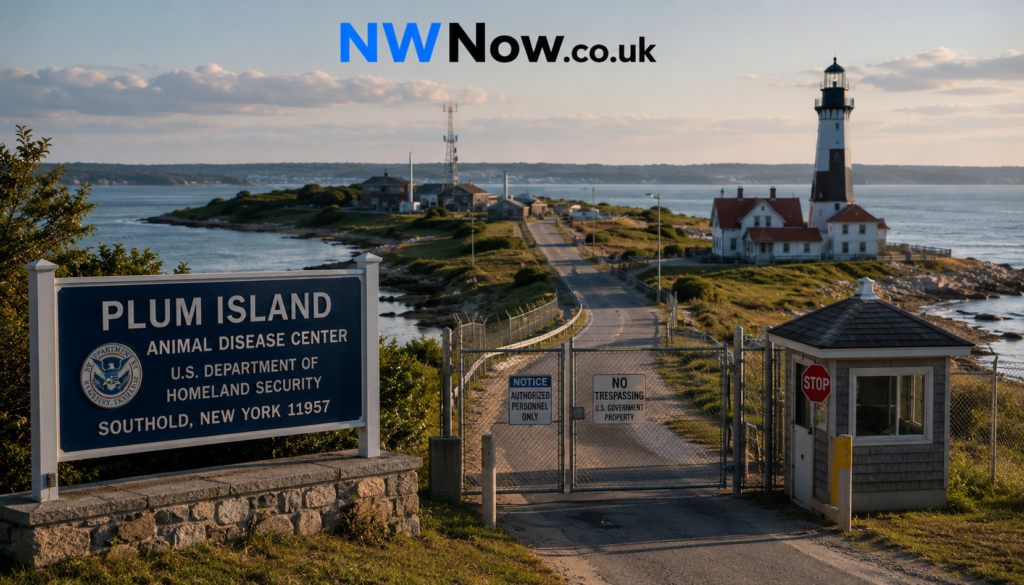

Plum Island, located in the town of Southold, Suffolk County, New York, is an island shrouded in mystery and scientific significance. Its mailing address, Southold, NY 11957, connects it to the picturesque North Fork of Long Island . Spanning about 840 acres, the island is situated in Gardiners Bay, east of Orient Point, just a short distance from the Connecticut coastline .
For over 70 years, Plum Island has been home to the Plum Island Animal Disease Center (PIADC), a high-security federal research facility tasked with protecting the U.S. food supply from devastating foreign animal diseases . This unique mission, combined with its long history of military use and the secrecy surrounding its operations, has cemented Plum Island’s place in popular culture as a site of intrigue, inspiring everything from conspiracy theories to best-selling novels.
Today, Plum Island stands at a crossroads. The research facility is in the process of closing, and a fierce debate is underway about its future: will it become a sanctuary for wildlife and public enjoyment, or will it be lost to private development?
A Storied History: From Native Lands to Fort Terry
Long before it became a laboratory, Plum Island had a rich and varied history. It was originally used by the Algonquin people for fishing, hunting, and growing corn . The name “Plum Island” is believed to come from the once-abundant beach plum bushes that grew there .
Colonial and Wartime Role
In 1659, the land was sold to an Englishman. For the next 250 years, it was primarily used for farming and livestock by local families. During the Revolutionary War and the War of 1812, it served as a strategic staging area for the British navy . In 1826, the federal government purchased land on the island to build a lighthouse, which became fully operational in 1827 and was replaced by the current Victorian Gothic Revival structure in 1869 .
Fort Terry
As the nation’s coastal defenses were modernised, the U.S. Army established Fort Terry on Plum Island in 1897 . The fort served various purposes, including as a staging area and sub-base during the World Wars. It was also the site of a notable court-martial in 1914 that had long-lasting repercussions on military policy .
The Plum Island Animal Disease Center (PIADC)
The most defining chapter in Plum Island’s modern history began in 1954, when the U.S. Department of Agriculture (USDA) established the Plum Island Animal Disease Center . Since 2003, it has been operated by the U.S. Department of Homeland Security (DHS) .
A “Super Prison” for Disease
The PIADC is a Biosafety Level 3Ag (Agriculture) facility, the only laboratory in the nation authorised to conduct diagnostic testing for foot-and-mouth disease (FMD) and other transboundary animal diseases . Its mission is to protect the U.S. agricultural sector, valued at billions of dollars, from outbreaks that could devastate the meat and dairy industries .
The facility was purposely built on an island to act as a natural quarantine, making it easier to prevent the accidental escape of pathogens . Security measures are extensive, with staff required to shower and change clothes before leaving, and all waste undergoing biological decontamination . This high level of security, combined with its secretive Cold War-era operations, has fuelled decades of myths, including claims of human-animal hybrids and the accidental release of Lyme disease . DHS has consistently denied these theories, stating they perform no classified work .
Key Research and Achievements
PIADC scientists have collaborated on high-impact research, developing vaccines, diagnostic tools, and decontamination technologies . A notable achievement was the centre’s role in the global eradication of rinderpest, a deadly cattle disease . It also maintains a vital vaccine bank to protect against the numerous strains of foot-and-mouth disease .
Location and the “11957” Connection
The zip code 11957 is associated with the Southold, New York, area, and Plum Island is officially part of the Town of Southold in Suffolk County . While the island itself is owned by the federal government and has no permanent population , its real estate listings, such as the exclusive property at 505 Plum Island Lane, use this address to denote its prime location on Long Island’s North Fork .
The Future of Plum Island
The future of Plum Island has been a subject of intense debate for over a decade, driven by the decision to close the PIADC and build a new, state-of-the-art facility, the National Bio and Agro-Defense Facility (NBAF), in Manhattan, Kansas .
Closure and Cleanup
All research work at PIADC is scheduled to end by 2026 . After the mission transfers, the DHS will oversee a lengthy decontamination and decommissioning process of the island’s high-containment facilities, expected to take four to six years .
The Battle for Preservation
A 2008 law mandated the sale of the island to the highest bidder to help fund the new Kansas facility . This triggered an enormous conservation effort led by organisations like The Nature Conservancy and Save the Sound, who argued that Plum Island’s unique natural and historical resources must be protected .
Their advocacy was successful. In December 2020, Congress passed a law blocking the public sale of the island . Today, the focus is on transferring stewardship to a public entity, with Suffolk County being the primary candidate . Current legislative efforts are focused on permanently preserving the island as a national monument or a protected conservation area .
Key Takeaways
-
Plum Island is an 840-acre island in Suffolk County, part of the town of Southold, NY, with a rich history spanning from Native American use to a strategic military fort.
-
For over 70 years, it has been home to the Plum Island Animal Disease Center (PIADC), the nation’s only lab for foot-and-mouth disease research.
-
The facility is closing, with operations moving to a new lab in Kansas, and a lengthy cleanup process is expected to follow.
-
While the island is rich in wildlife, including seals and piping plovers, and currently off-limits to the public, its future is likely to be one of conservation and public use rather than private development.
Frequently Asked Questions
What is Plum Island, New York?
Plum Island is an island in the Town of Southold, Suffolk County, New York, located in Gardiners Bay off the North Fork of Long Island. It is home to the Plum Island Animal Disease Center (PIADC), a federal research laboratory .
What happens at Plum Island?
For decades, the primary activity on Plum Island has been research on highly contagious animal diseases at the PIADC. This work includes vaccine development, diagnostics, and training for veterinarians to protect the US agricultural industry .
Why was Plum Island so secretive?
Plum Island became a subject of mystery due to its high-security research on deadly animal diseases, which was especially sensitive during the Cold War. The island’s restricted access and the nature of its work led to the spread of numerous conspiracy theories .
Is Plum Island accessible to the public?
No. Plum Island is federally owned and access is strictly controlled by the Department of Homeland Security. It has been off-limits to the public for decades to ensure the safety and security of its research mission .
What is the future of Plum Island?
The PIADC is in the process of closing, and the island’s future is being debated. Congress has blocked a sale to private developers, and there is a strong push to preserve the island for conservation and public use, with local officials considering taking over its stewardship .
Conclusion
Plum Island is far more than just a zip code. It is a place where history, science, and nature converge into a compelling and complex story. Its transition from a top-secret biological defense laboratory to a potential public sanctuary marks the end of one era and the hopeful beginning of another. While its future remains a subject of ongoing political and environmental debate, one thing is certain: Plum Island’s legacy will continue to captivate the public imagination for generations to come.
Read more Eva Marcille Twin Sister: The Truth Behind the Long-Running Rumor