
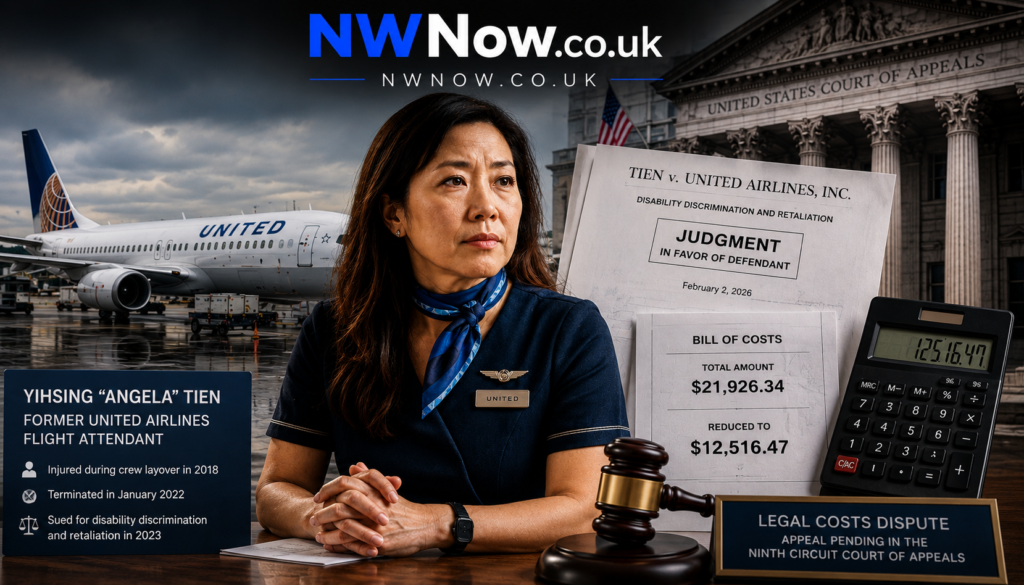

A former United Airlines flight attendant is fighting a legal battle that has captured widespread attention, not just for its allegations of disability discrimination, but for the subsequent fight over legal costs. Yihsing “Angela” Tien, a 51-year-old former flight attendant, filed a lawsuit against the airline in 2023, claiming she was wrongfully terminated after a serious injury in 2018 .
After a three-year legal battle that ultimately ended in United’s favour, the airline sought nearly $22,000 in legal costs from the former employee. The case has now become a focal point for discussion about the financial disparity between corporate giants and individual plaintiffs in civil rights litigation.
The Background of the Case
The Injury and Medical Leave
Yihsing Tien began working for Chicago-based United Airlines in 2013 and was considered a high-performing crew member . Her career took a dramatic turn on October 30, 2018, when she was “severely injured when she fell on the premises of a hotel” during a crew layover . The fall resulted in injuries to both knees, her left elbow, left shoulder, and right wrist .
Tien was placed on medical leave and underwent surgery to address her injuries . On or about January 25, 2019, she received a letter from United’s supervisor of in-flight services stating she could remain on approved medical leave through January 25, 2023 .
The Termination and Dispute
However, on January 25, 2022, Tien’s employment was terminated without notice . Tien argued that United’s initial letter was inaccurate, as the airline’s maximum leave of absence was three years, meaning she needed to return to work before January 25, 2022 .
Tien claimed United did not reach out regarding a return-to-work plan during her time away. The first contact she had with United during her leave was the January 2022 letter terminating her employment .
Tien fought to get her job back, arguing that if she had known the correct end date of her leave, she could have tried to return or find reasonable accommodations to work . United dismissed the appeal, stating that she should have been able to calculate the leave’s end date herself, regardless of what the company’s letter stated .
The Lawsuit: Allegations and Claims
The Legal Action
Tien sued United Airlines in a California district court, alleging disability discrimination and retaliation . Her complaint also included a supervisor, Talia Espinoza, for harassment under California’s Fair Employment and Housing Act (FEHA) and intentional infliction of emotional distress .
The Fraudulent Joinder Argument
United Airlines argued that Espinoza was “fraudulently joined” to defeat diversity jurisdiction. To prove fraudulent joinder, a defendant must show either actual fraud or that the plaintiff cannot establish a cause of action against the non-diverse party .
The court found that Tien’s allegations against Espinoza were based on a single communication and did not rise to the level of severe or pervasive conduct required to establish a hostile work environment under FEHA . Personnel management decisions, such as termination, typically do not constitute harassment . The court concluded that Tien’s allegations against Espinoza were legal conclusions rather than factual claims, justifying removal to federal court .
The Court’s Decision
The case was ultimately decided in United’s favour on February 2, 2026 . The court granted United’s motion for summary judgment, meaning Tien lost her case .
The Legal Costs Battle
The Bill of Costs
Upon winning, United filed a bill of costs totalling $21,926.34 for Tien to pay in full . This included legal fees and court costs.
Tien’s legal team objected, arguing that the amount was excessive given her financial situation compared to United’s massive revenue. As her attorneys wrote: “Now United Airlines, Inc. — a carrier that reported $59.1 billion in operating revenue in fiscal year 2025 — seeks $21,926.34 in costs from the woman who worked as its flight attendant” .
They added: “To Ms. Tien, this cost amount represents more than twice her total income from all sources in the past year and compelling her to pay it would require liquidating the investment holdings that sustain her daily life. By comparison, the amount United seeks represents approximately 0.000037 per cent of its annual revenue — the financial equivalent of rounding error to a corporation of this scale” .
Court Review and Reduction
Court records show the bill of costs was subsequently reduced to $12,516.47 . However, Tien’s attorneys continued arguing that amount was still far too high. “The economic disparity between a former flight attendant with no financial safety net and a carrier reporting $59.1 billion in annual revenue is not merely significant — it is extraordinary,” Tien’s representation wrote in a motion to re-tax costs .
On April 22, 2026, the court granted Tien’s motion for review of taxation and costs, citing her “limited means” and “the potential of chilling important civil rights litigation” .
The Appeal Process
According to records from the U.S. Court of Appeals for the Ninth Circuit, Tien’s brief was due June 22, 2026, and United’s response is due July 22, 2026 . The court will review whether Tien should be required to pay any of United’s legal costs .
The Broader Significance
The Disparity Argument
The case has highlighted the stark financial disparity between corporations and individuals in civil rights litigation. Tien’s attorneys have emphasised this point repeatedly: “Ms. Tien did not lose because her claims were frivolous — five of nine causes of action survived United’s motion to dismiss. The ultimate result turned on narrow factual distinctions rather than legal insufficiency. She lost because United’s reliance on the terms of the collective bargaining agreement proved dispositive in a close and contested record” .
The Chilling Effect on Litigation
Judge Jeffrey White noted the importance of the case for civil rights litigation, citing “the potential of chilling important civil rights litigation” when considering whether Tien should pay costs . This reflects broader concerns that the threat of substantial legal costs could discourage individuals from pursuing legitimate discrimination claims.
Key Takeaways
-
Yihsing Tien, a former United Airlines flight attendant, sued the airline for disability discrimination and retaliation after she was terminated following a 2018 injury
-
United won the case on summary judgment on February 2, 2026, after a three-year legal battle
-
United sought nearly $22,000 in legal costs from Tien, later reduced to $12,516
-
Tien’s attorneys argued the costs would be a financial hardship, noting United’s $59.1 billion annual revenue
-
The court granted Tien’s motion for review of costs, citing her limited means and the potential of chilling civil rights litigation
-
The case is now being reviewed by the Ninth Circuit Court of Appeals
Frequently Asked Questions
What is the United Airlines Yihsing Tien lawsuit about?
The lawsuit involves Yihsing Tien, a former United Airlines flight attendant who sued the airline for disability discrimination and retaliation after she was terminated following a serious injury in 2018 .
What happened to Yihsing Tien?
Tien was injured during a crew layover in October 2018 and placed on medical leave. Despite receiving a letter stating her leave extended to January 2023, she was terminated in January 2022 without notice .
Did Yihsing Tien win her case?
No. United Airlines won the case on summary judgment on February 2, 2026 .
How much did United Airlines seek in legal costs?
United initially sought $21,926.34 in costs. This was later reduced to $12,516.47 on review .
What is the status of the case now?
The case is currently being reviewed by the Ninth Circuit Court of Appeals. Tien’s brief was due June 22, 2026, and United’s response is due July 22, 2026 .
What was the court’s reasoning for reviewing the costs?
The court cited Tien’s “limited means” and “the potential of chilling important civil rights litigation” in granting her motion for review .
Why did Tien lose her case?
While five of her nine claims survived United’s motion to dismiss, the court ultimately found that United’s reliance on the terms of the collective bargaining agreement was dispositive in a close and contested record .
How does United Airlines’ revenue compare to the costs sought?
United reported $59.1 billion in operating revenue in fiscal year 2025. The initial $21,926.34 in costs represented approximately 0.000037% of this revenue .
Conclusion
The case of Yihsing Tien v. United Airlines serves as a stark illustration of the challenges individuals face when taking on corporate giants in civil rights litigation. While Tien’s disability discrimination claims were ultimately unsuccessful, her ongoing fight against the legal costs she has been ordered to pay has become a symbol of the broader struggle for justice in an unequal system.
The court’s recognition of the “chilling effect” that substantial legal costs could have on civil rights litigation reflects the importance of cases like this one. The Ninth Circuit’s upcoming decision on whether Tien should be required to pay any of United’s costs will have implications far beyond this single case.
Read more