
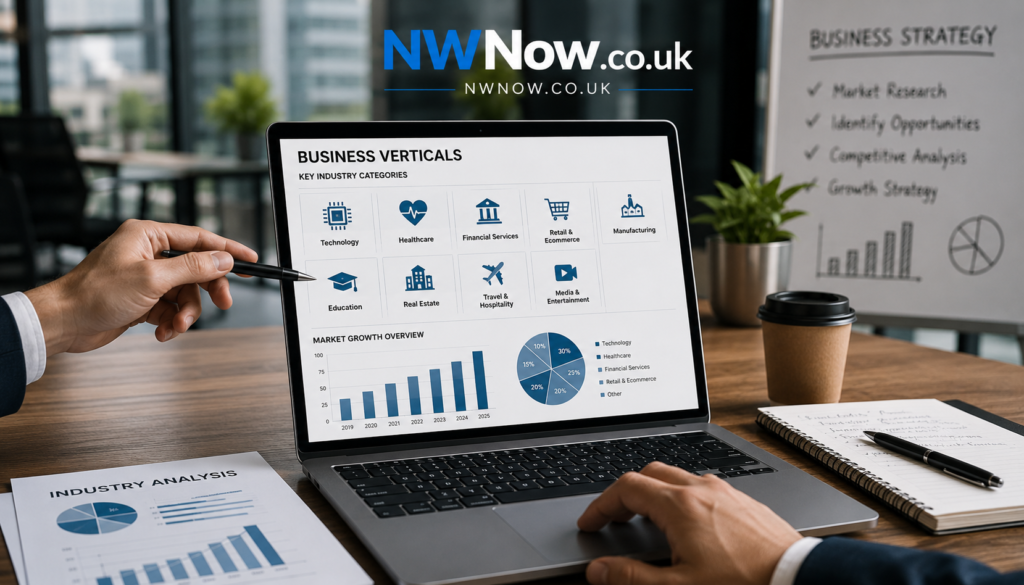

Classifying your business is not just a bureaucratic exercise. It is a strategic necessity that influences everything from how investors perceive you to how you benchmark against competitors.
Business vertical classification categories provide a framework for understanding where a company fits within the broader economy. These systems help investors identify opportunities, help companies target the right customers, and help researchers analyse market trends.
Understanding business vertical classification categories is essential for entrepreneurs, investors, and business professionals. This guide explores the key classification systems, the difference between verticals and horizontals, and practical examples to help you navigate the landscape.
What Are Business Vertical Classification Categories?
A business vertical is a specific niche market or industry segment where companies offer specialised products or services tailored to a particular group of customers . Think of it as a distinct slice of the market pie, defined by a specific customer need, product type, or production process .
Vertical classification systems group companies that focus on a shared niche or specialised market spanning multiple industries . Unlike traditional industry classifications, verticals often cut across traditional boundaries to capture emerging fields like fintech, edtech, or adtech.
For example, a company like SoFi operates in the consumer finance industry but is classified under the fintech vertical . This approach provides more granularity than traditional industry codes, making it easier to identify peers and competitors.
Traditional Classification Systems: NAICS and SIC
Before modern verticals emerged, businesses were classified using standardised codes developed by government agencies.
NAICS (North American Industrial Classification System)
NAICS is the standard used by federal statistical agencies in North America for classifying business establishments . It uses a six-digit hierarchical code that groups businesses by their primary activities.
For example:
-
23 Construction
-
51 Information
-
54 Professional, Scientific, and Technical Services
NAICS helps with statistical analysis, policy development, and regulatory compliance.
SIC (Standard Industrial Classification)
SIC is an older system that was replaced by NAICS in many contexts. It uses four-digit codes to classify industries. While NAICS is the primary system used by government agencies, SIC codes are still referenced in some databases and research.
These traditional systems provide a solid foundation but may not capture emerging business categories like AI startups or blockchain companies.
Modern Vertical Classification Systems
As the economy has evolved, more dynamic classification systems have emerged. These modern approaches capture the nuances of contemporary business.
PitchBook Industry Verticals
PitchBook categorises companies by 50+ industry verticals, grouping businesses that focus on a shared niche or specialised market . Examples of PitchBook verticals include:
| Vertical | Description |
|---|---|
| Adtech | Software and services that deliver, control and target online advertising |
| Agtech | Hardware and software that automate and manage farming |
| AI/ML | Intelligent computers and machine learning applications |
| Fintech | Technology facilitating financial services |
| Edtech | Software enhancing teaching and learning |
| Digital Health | Hardware and software for health tracking and telemedicine |
impact.com uses verticals to group similar businesses for benchmarking and performance comparison . Their categories include:
-
Apparel, Shoes, and Accessories
-
Arts and Entertainment
-
B2B, Services, and Office
-
Financial, Insurance, and Legal Services
-
Health and Beauty
-
Home and Garden
-
Travel
Each vertical has clear inclusion and exclusion criteria. For example, sports apparel falls under “Apparel, Shoes, and Accessories,” while sports equipment is classified under “Sports, Outdoors and Fitness” .
NIH Research Vertical Categories
A 2024 NIH study offers another perspective, classifying businesses across 11 verticals for health-related research . This classification is valuable for understanding how businesses intersect with health outcomes:
-
All (all businesses in a polygon)
-
Grocery and Convenience Stores
-
Retail
-
Restaurants
-
Local Events
-
Professional Services
-
Business and Utility Services
-
Home Services
-
Lifestyle Services
-
Travel
-
Manufacturing
-
Public Good
This approach demonstrates how vertical classification serves diverse purposes, from commercial analysis to public health research.
Vertical vs. Horizontal Business Models
Understanding the distinction between vertical and horizontal businesses is crucial for strategic positioning .
Horizontal Businesses
Horizontal companies offer products or services that appeal to customers across multiple industries. They focus on broad reach rather than deep specialisation.
Key Characteristics:
-
Serve a wide range of industries
-
Offer standardised, non-specialised solutions
-
Target a large, diverse market
-
Often have lower barriers to entry
Examples: Salesforce (CRM software for any industry), HubSpot (marketing tools for any business), and Microsoft Office 365 (productivity tools used across sectors) .
Vertical Businesses
Vertical companies focus on a specific industry or niche. They develop deep expertise and tailored solutions for that market.
Key Characteristics:
-
Serve a narrow, specialised market
-
Offer customised solutions for industry needs
-
Build expertise and competitive advantage
-
Often have higher barriers to entry
Examples: A company developing patient-scheduling software specifically for healthcare providers or an online marketplace for used car parts .
Comparison Table
| Aspect | Horizontal | Vertical |
|---|---|---|
| Market Coverage | Broad across industries | Narrow, focused on a niche |
| Product Customisation | Standardised solutions | Tailored to industry-specific needs |
| Barriers to Entry | Lower | Higher |
| Competition | Intense, many players | Reduced, fewer specialists |
| Expertise | General business functions | Deep industry knowledge |
Common Business Vertical Categories
Here are some of the most widely recognised business vertical categories:
Retail and Ecommerce
-
Grocery and convenience stores
-
Department stores
-
Apparel, shoes, and accessories
-
Computers and electronics
Professional Services
-
Legal services
-
Accounting and tax preparation
-
Consulting
-
Medical and healthcare services
Technology
-
Software and SaaS
-
Hardware and devices
-
AI and machine learning
-
Cybersecurity
-
Cloudtech and DevOps
Financial Services
-
Banking
-
Insurance
-
Fintech
-
Investment services
Healthcare
-
Digital health
-
Pharmaceuticals
-
Medical devices
-
Wellness and telehealth
Consumer Goods
-
Personal care
-
Home and garden
-
Pet supplies
-
Jewelry and accessories
How to Choose the Right Classification for Your Business
Selecting the correct vertical classification is important for market positioning, investor targeting, and competitive analysis.
Steps to Identify Your Vertical
-
Define Your Core Offering: What product or service do you provide? Who is your target customer?
-
Analyse Your Competitors: Look at how similar companies are classified. What verticals do they appear under?
-
Consider Your Market: Are you serving a broad or narrow audience? Do you have deep industry expertise?
-
Review Classification Systems: Check how systems like NAICS, PitchBook, or impact.com categorise your business type.
-
Be Specific: More specific classifications often help with targeting and benchmarking. A fintech company, for example, is better defined than a generic “technology” company.
Common Mistakes to Avoid
Choosing Too Broad a Category: A category like “technology” or “retail” may be too vague to provide meaningful insight.
Ignoring Emerging Verticals: Newer categories like climate tech or agtech may better describe modern businesses than traditional industry codes.
Misunderstanding Vertical vs Horizontal: A company can offer both vertical and horizontal products. Consider your primary focus.
Benefits of Understanding Business Vertical Classification
For Investors and Analysts
Vertical classification helps investors identify investment opportunities, benchmark portfolio companies, and spot emerging trends. PitchBook’s vertical system enables users to find comparables and analyse market performance .
For Business Owners
Understanding your vertical helps with positioning, marketing, and competitor analysis. It allows you to identify your true peers and benchmark performance . It also helps with investor targeting, as many investors focus on specific verticals.
For Marketers
Vertical classification enables more targeted marketing campaigns. By understanding your vertical, you can tailor messaging to industry-specific pain points and needs. This leads to higher conversion rates and more effective spending.
Future Trends in Business Classification
The way we classify businesses is evolving. Several trends are shaping the future of business verticals:
Increasing Granularity: As markets fragment, new verticals are emerging. Climate tech, Web3, and generative AI are examples of recent additions.
Hybrid Categories: Some businesses span multiple verticals. Platforms that combine ecommerce, logistics, and fintech are increasingly common.
AI-Driven Classification: Machine learning is being used to classify businesses more accurately and dynamically, adapting to new categories as they emerge.
Sustainability Focus: New verticals are emerging around sustainability, including renewable energy, circular economy, and carbon capture.
Key Takeaways
-
Business vertical classification categories group companies by specialised markets or niches
-
Traditional systems like NAICS provide a foundation, while modern verticals capture emerging categories
-
Vertical businesses focus on specific industries, while horizontal businesses serve multiple sectors
-
Common verticals include retail, technology, financial services, healthcare, and consumer goods
-
Choosing the right classification is essential for targeting investors, benchmarking, and strategic positioning
-
The classification landscape is becoming more granular and dynamic, with new verticals emerging regularly
Frequently Asked Questions
What are business vertical classification categories?
Business vertical classification categories are systems that group companies by specialised markets or industry niches. They help investors, analysts, and business owners understand market structure and identify peers .
What is the difference between NAICS and business verticals?
NAICS is a government classification system that groups businesses by economic activity using standardised codes . Business verticals are more flexible, often emerging to capture new categories like fintech or agtech that may span multiple NAICS codes .
What is an example of a business vertical?
Fintech is a business vertical that includes companies using technology to provide financial services. Examples include online banking platforms, insurance technology, and payment processing companies .
What is the difference between vertical and horizontal markets?
Vertical markets focus on a specific industry or niche with specialised offerings. Horizontal markets serve customers across multiple industries with standardised products or services .
How do I identify my business vertical?
Start by defining your core offering and target customer. Research how competitors are classified. Consider your market breadth and depth of expertise. Then match your profile to existing vertical categories in systems like PitchBook or impact.com .
Why are business verticals important?
Verticals help with market analysis, competitor identification, investor targeting, and benchmarking. They provide a more granular view of the market than traditional industry codes .
Conclusion
Business vertical classification categories are essential tools for understanding the modern economy. They provide a framework for identifying competitors, targeting investors, and benchmarking performance. Traditional systems like NAICS offer a solid foundation, while emerging verticals capture the dynamism of sectors like technology, finance, and healthcare.
For entrepreneurs, choosing the right classification helps position the business effectively. For investors, it enables more precise analysis and identification of opportunities. For researchers, it provides a consistent framework for comparing companies across sectors.
As the economy continues to evolve, the landscape of business verticals will become even more dynamic. Staying informed about these classification systems is essential for anyone involved in business, investment, or market analysis.